Commercial & industrialUpdated 4 August 202611 min read
Three-phase work on small commercial sites
A café, a workshop or a two-tenancy shopfront is still a three-phase installation, and it will punish a contractor who treats it like a big house. Load balance, isolation, the MEN, motors, kitchens and the moment you must call the DNSP are the difference between a clean job and a week of brownout complaints.
By Tom Rafter
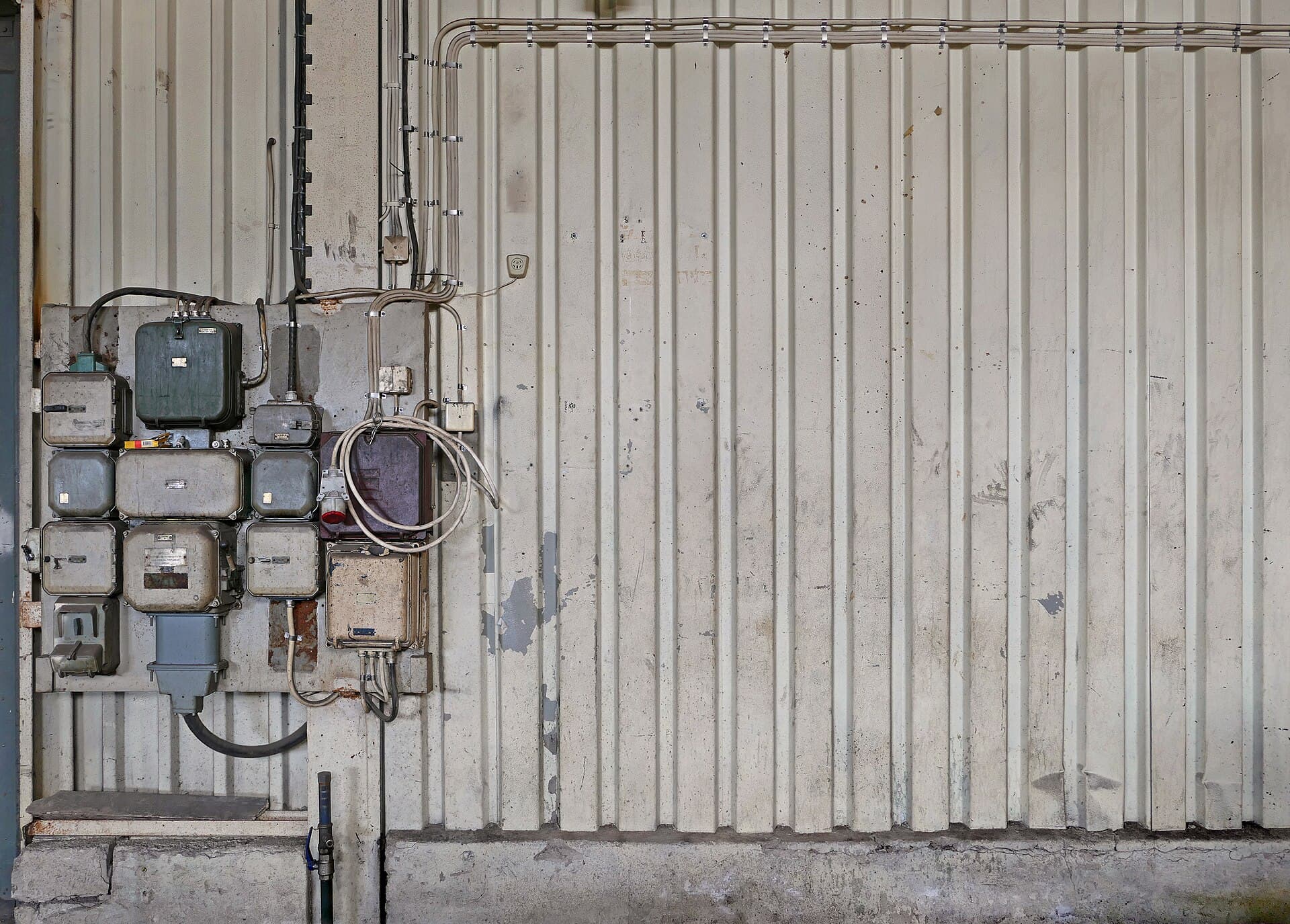
Small commercial three-phase work is where residential habits go to die. The board looks familiar. The colours are the same. The owner still talks about “the power” as if it were one thing. Then a combi-oven, a scroll saw and a ducted unit start on the same phase, the lights in the front shop go brown, and the tenant in the next suite swears you have been in their board.
The commercial and industrial jobs that pay are not always factories. They are bakeries, smash repairs, dental rooms, small warehouses and the shopfront that was a florist and is now a noodle bar. The Wiring Rules still apply. So do the distributor’s service and installation rules, which are not the same document as AS/NZS 3000 and are not optional because the site is “only a little one”.
What “small” still is
A 100 amp three-phase overhead service into a brick shop is a small commercial installation. It is also enough energy to start a fire, lift a motor that has seized, or put a dangerous potential on a fridge carcass if the earthing arrangement is wrong. Treat the current as what it is.
Read the existing arrangement before you quote. Find the point of supply, the meter, the main switch, the MEN link, the earth electrode, and every sub-board the landlord has allowed a previous contractor to invent. A “simple” oven circuit is not simple if the only spare ways are on a tenant board that was never meant to carry a 32 amp three-phase load, or if the consumer mains are already warm.
Maximum demand is not a vibe. AS/NZS 3000 gives you methods. Use one. Write down the figures you used and the loads you counted. If the existing installation is already at the edge, the honest quote is “we need the distributor”, not “we will see how it goes”. Seeing how it goes is how you inherit brownouts.
Load balance is a site habit, not a spreadsheet flourish
On a house you can get away with a messy phase rotation because the load is small and the occupants are one family. On a small commercial site the loads are peaky and they cluster. Kitchens want the morning. Workshops want the compressor after lunch. Air-conditioning wants the first hot day in November.
Balance at the main board, then check again at the tenant board. A beautiful split at the main switches means nothing if one tenancy has put every single-phase appliance on red because that was the first spare way.
When you add a load, measure what is there. Clamp each phase at the time of day the new equipment will run. A Monday morning walk-through is a poor sample for a café that dies at Saturday brunch.
Record the phase of every new circuit on the legend and on the job notes. The next person will not thank you for “SPARE” written in Texta over a 20 amp that is feeding a dough mixer.
If you are handed a three-phase appliance that is actually three single-phase elements in a trench coat, ask for the manufacturer’s current per phase and the recommended supply. Some commercial ovens are ugly on one phase by design. You cannot balance a load that was never balanced in the factory, but you can put it on the phase that can take it and tell the client why the other two phases are not a free lunch.
Isolation that a cook or a fitter can understand
Isolation and lockout on a small commercial site is not a HV permit system. It is still the difference between a person who goes home and a person who does not.
Every motor, every oven pack and every tenant board needs a means of isolation that is identifiable and accessible. AS/NZS 3000 is not vague about this. A main switch two rooms away, behind a padlocked landlord cupboard, is not isolation for a kitchen hand who has to clean a slicer.
Label the isolator with the equipment it kills, not with the circuit number you used in your head. If two ovens share a distribution board, do not make the only isolation the main switch for the whole kitchen.
Lockable isolators are cheap compared with a workers’ compensation claim. If the site has a permit system — and many small factories and food plants do, even when the office is a donga — work inside it. Your own padlock on a hasp is not a conflict with their permit. It is the bit that makes their permit real.
Do not isolate a tenant by killing the landlord’s main and walking away. Tell the other occupants. Put it in the diary. A medical tenancy, a coolroom or a server in the back office will not regard your silence as professionalism.
The MEN is not a suggestion
The multiple earthed neutral arrangement is how Australian low-voltage installations keep exposed metal near earth potential. On a small commercial site it is also how a bad connection becomes a shop full of tingling fridges.
There is one MEN link at the main earthing point, unless the installation has been deliberately arranged otherwise under the Rules and the distributor’s requirements. Downstream boards get an earth bar and a neutral bar that do not meet. Mixing them up because “it is only a sub-board in the workshop” is how you put neutral current on the earth and how you create a potential on every stainless bench.
Look at the electrode. Look at the main earth conductor. Look at whether someone has used the water pipe as an afterthought. Look at whether a steel shed has been bonded, or whether it is sitting there as a separate metallic surprise. AS/NZS 3000’s equipotential bonding requirements are not only for bathrooms.
If you find a second MEN in a tenant board, do not just rip it out on a Saturday because it offends you. Work out why it is there. Some older arrangements were built as if each tenancy were a separate installation. Some are simply wrong. The fix may be a bonding conductor, a distributor visit, or a conversation with the licensed contractor who owns the main board. Document what you found. Photograph it. Then fix it under a method you can defend.
Motor loads, inrush and the workshop that trips on start
Workshops collect motors. Compressors, hoists, dust extractors, welders, and the coolant pump that only runs when the lathe is cutting. Direct-on-line starting on a small service is a brownout generator. Soft starters and VFDs are not luxury items; they are how you keep the lighting and the neighbour’s computer alive.
A VFD is also a source of leakage and harmonics. Type A RCDs may nuisance-trip. The answer is not to remove the RCD. The answer is the protective device the manufacturer and AS/NZS 3000 allow for that equipment, installed by someone who has read both. If you are not sure, stop. A workshop owner who wants “less tripping” is not asking you to leave them unprotected.
Welders are their own argument. Some want a dedicated outlet, a dedicated circuit, and a conversation about duty cycle. A 15 amp general-purpose outlet on a workshop bench is not a welding bay. If the welder’s nameplate current and the service cannot be friends, that is a DNSP conversation or a “buy a smaller welder” conversation. It is not a “put it on the compressor circuit and see” conversation.
Mechanical protection, emergency stops and the isolation at the machine are part of the electrical job when you supplied the circuit. Do not draw an imaginary line at the isolator and pretend the missing e-stop is the fitter’s problem if you were contracted to make the machine runnable.
Kitchens: steam, grease and three-phase elements
A commercial kitchen is a wet, hot, greasy electrical environment with a lot of metal and a lot of people who are not electricians. IP ratings, RCD protection, and the location of outlets matter more here than in a dry office.
Three-phase appliances will still have single-phase controls, lights and fans. Read the schematic. A combi-oven that loses a phase can sit there cooking on two and then wreck a heating element, or it can sit there looking dead while the kitchen blames you. Phase-failure protection is not exotic on equipment that costs more than your van.
Grease gets into everything. Isolators belong where they can be reached with a wet hand in mind — not over the fryer, not behind a bench that cannot be moved, not in a position that requires standing on a milk crate. AS/NZS 3000’s rules about switches and socket-outlets in wet areas are the starting point, not the finishing point. The health inspector will have opinions too.
Gas interlocks, exhaust fans and fire-suppression systems wander into the electrical scope whether you quoted them or not. Find out who owns those interfaces before you isolate a kitchen for a “simple” oven swap.
Tenant boards and the landlord’s cupboard
Strip-shopping and small industrial estates live on tenant boards. Some are proper sub-boards of one installation. Some are a tangle of extra meters, landlord lights and a solar inverter that was added in 2017 with no legend.
Establish who the customer is. Your contract with a tenant does not give you a free hand in the landlord’s main. Your contract with a landlord does not let you starve a tenant of isolation. Write down the boundary.
Labelling is not decoration. A tenant must be able to isolate their own installation. A firefighter must be able to find the main. A meter reader must be able to read the meter without removing your new ducting. Distributor service rules are explicit about clearances and access. They will fail you for a neat board that nobody can open.
If you add a tenant board, run it as a real board: incoming isolation, correct earthing, spare capacity that you have actually calculated, and a legend that will still be true in five years. Do not feed it from a way labelled “SPARE — DO NOT USE” that a previous contractor left as a warning.
Shared neutrals between tenancies are a defect and a fight waiting for a Saturday. If you find one, treat it as a safety issue, not as a curiosity.
When you need the DNSP
The distribution network service provider owns the network, the service fuse, often the meter, and the rules about how you connect. You need them when the work crosses the connection point or changes what the network is expected to deliver.
Typical triggers on small commercial sites: upgrading consumer mains; changing from overhead to underground; adding load that exceeds the existing service rating; relocating the point of attachment; installing or altering generation; changing a metering arrangement; a burnt service fuse that keeps returning because the load is wrong, not because the fuse is unlucky.
Do not enlarge a main switch and call the job done. The fuse at the pole or in the pillar is the real limit. If you do not know what that fuse is, find out. The tenant’s “we have three-phase” is not a current rating.
Each state and territory has an electrical safety office that cares about licensing and the safety of the installation — Energy Safe Victoria, the Electrical Safety Office in Queensland, NSW Fair Trading, Building and Energy in Western Australia, and their colleagues. They are not the DNSP. Ringing the safety office will not get a larger service fuse.
Brownouts, complaints and the job you thought was finished
Voltage complaints on small commercial sites have a short list of usual suspects. A high-resistance neutral. An unbalanced load. A service that is too small. A loose connection at the point of attachment. A neighbour with a welder. A long run of undersized cable to a tenant board. LED drivers that sag and flicker when a motor starts.
Do not start at the LED. Start at the supply. Measure voltage phase-to-phase and phase-to-neutral at no load and at peak load. Measure current on each phase and on the neutral. Feel the connections — with the right method, not with the back of your hand on a live bar. If the voltage is poor on the line side of the main switch, you are in DNSP territory.
Write it down. A complaint that “the lights dip when the oven door opens” is a gift. Capture the current and the voltage at that moment. A story without numbers is a story the owner will use against the next invoice.
If you caused the imbalance by adding a load, own it and rebalance. If you inherited a marginal service, say so in the report and stop short of promising a cure you cannot deliver without the network.
Documentation that will still make sense
A small commercial board should leave you with: an updated legend; a test sheet that matches AS/NZS 3000’s verification requirements; a certificate of compliance in the form your state uses; photographs of the MEN, the incoming arrangement and the finished interior; and a note of any defect you found and did not fix, with the reason.
Defects you walk past become yours in the client’s memory. If the earth electrode is a mystery and you were only there to add a circuit, write that the electrode was not verified. Then decide whether you can ethically leave it. Some defects are not optional souvenirs.
Data and extra-low voltage will be in the same cupboard. So will the access-control power supply someone stuffed in beside the main switch. Leave room, leave labels, and do not let a low-voltage mess sit on a bare busbar.
If the site later goes onto an industrial maintenance contract, the file you leave is the difference between a planned isolation and a two-hour hunt.
Small commercial three-phase checklist
- Find the connection point, service rating, meter, main switch, MEN and electrode before you price the job.
- Calculate maximum demand. If the new load does not fit, stop and talk to the DNSP.
- Clamp the existing phases at the time the new equipment will run, not at a quiet hour.
- Give every motor and every major appliance an identifiable, accessible isolator.
- Do not add a MEN link in a downstream tenant board. Photograph the main MEN as found.
- In kitchens, treat steam and grease as the environment. Position isolators for a wet, hurried hand.
- Label tenant boards so a stranger can isolate one tenancy without killing the street.
- Record voltage and current if anyone mentions dipping lights. Numbers beat adjectives.
- Issue the state certificate. Update the legend. Keep photos of the MEN and the incoming arrangement.
- Write down defects you found and did not fix. Some of them you should not leave.
Three-phase on a small site is ordinary work. Ordinary is not the same as casual. The installations that go wrong are the ones where someone assumed a shop was a house with a bigger board.
Questions contractors ask
- When does a small commercial job need the DNSP, not just the contractor?
- When you are altering the consumer mains, the point of attachment, the metering arrangement, the maximum demand in a way that changes the service, or anything on the network side of the connection point. Adding a welder or a combi-oven that pushes the installation past what the service can deliver is a network conversation. Your state electrical safety office does not size the fuse at the pole.
- Is a tenant board allowed to have its own MEN link?
- Follow AS/NZS 3000 and the distributor’s service rules. A MEN link belongs at the main earthing point of the installation. Extra links in downstream tenant boards are a classic defect and a classic source of neutral current on the earth path. If the tenancy is a separate installation with its own connection, that is a different animal — and it will be written that way on the plan.
- Why do cafés keep complaining about lights dipping when the coffee machine starts?
- Because a single-phase element or a poorly balanced three-phase load is sitting on a service that was sized for a sandwich shop. Measure the current on each phase at the peak, not at 10am on a Tuesday. Then look at the incoming service and the MEN before you blame the LED drivers.