Safety & testingUpdated 11 August 202611 min read
SWMS for electrical work that people will actually use
A safe work method statement is not a PDF you email on Sunday night. It is the isolation and test sequence for this board, on this day, written so the people on the tools can follow it and an inspector can see that they did.
By Priya Nair
A safe work method statement that nobody reads is not a conservative document. It is a fiction. The people on the tools will do the job the way they always do it, and the folder in the site office will contain a twelve-page PDF that describes a different board, a different voltage and a set of hazards copied from a civil template. When something goes wrong, that PDF is what the inspector reads first. When nothing goes wrong, it has still failed, because the WHS duty was to carry out the work in accordance with the statement, not to possess one.
The model WHS regulations require a SWMS for high-risk construction work. Electrical contractors trip that definition more often than they admit. Construction work carried out on or near energised electrical installations or services is on the Safe Work Australia list. Electrical work on energised equipment has its own SWMS duty in the electrical division of the same regulations. AS/NZS 4836 wants a site assessment before you start; WorkSafe Victoria has said a proper SWMS meets that assessment for this kind of work. Energy Safe Victoria and the Electrical Safety Office both expect the live-work preliminary steps to be written down. None of them is asking for a novel. They are asking for a method that can be used.
This piece sits next to the isolation article on purpose. If the SWMS cannot describe isolation and prove-dead in verbs, it cannot describe electrical work.
What actually triggers a SWMS
High-risk construction work is a defined list in the model WHS regulations. Safe Work Australia publishes it, and the states that have adopted the model copy it with local numbering. The electrical item is construction work carried out on or near energised electrical installations or services. Other items on the same list attach themselves to electrical jobs without asking: a risk of a fall of more than two metres on a roof PV array, work near a trench deeper than 1.5 metres, work near powered mobile plant, work on or near a road, a contaminated or flammable atmosphere, asbestos in a switchboard surround.
If the job is construction work and it is on or near an energised installation, you need a SWMS before the work starts. "Near" is why an isolated sub-circuit on a live switchboard still triggers the document. If you can make the work not-near by isolating and shrouding, do that, and write that isolation as the method. Do not claim the job was not near because you were not in the mood to write a SWMS.
Energised electrical work — live work — requires a SWMS under the electrical regulations whether or not you are on a construction site. The model code is explicit. So is Energy Safe Victoria's regulation on how installation work on energised equipment is to be carried out. If you have decided the job is live, you already owe a SWMS. If you have decided the job is work near live parts, check the construction trigger and the state electrical safety regulation before you decide you do not.
A SWMS is not required for every other electrical activity. Replacing a socket in a house, after isolation, is not automatically high-risk construction work. You still have WHS duties and electrical-safety duties. You still isolate and prove dead. You do not have to manufacture a SWMS so that a builder's gate system has a PDF to ingest — unless that builder's system is the price of entry, in which case you write a short, true one rather than a long, false one.
Principal contractors will ask for a SWMS on jobs that do not strictly trigger the regulation. That is their contract. It does not change the legal minimum, and it does not justify pasting a generic. If they want a document, give them the document you will actually work to.
Generic PDFs versus a site-specific method
The generic PDF is a known product. It has a company logo, a hazard table that begins with "slips, trips and falls", a control that says "competent persons to carry out works", and a sign-on sheet. Somewhere in the middle is the word "electrical". It was written once, for a tender, and it has been emailed to every site since.
Inspectors have seen it. They look for the name of the site, the identification of the board or the equipment, the sources of supply, the isolation point, the prove-dead steps, the names or roles of the people, and the bit that says what happens if the method cannot be followed. They look at the date and they ask the apprentice what the isolation point is. If the apprentice points at a different breaker from the one in the PDF, the document has failed even if nobody has been hurt.
Site-specific does not mean you write forty pages from a blank screen every morning. It means the reusable bones — how this company isolates, how it proves dead, how it uses hasps, how it restores — are married to today's facts. Building, board, circuit, sources (including photovoltaic, battery, generator, UPS), other trades, access and escape, who holds the locks, who is the observer if there is one, and which prescribed circumstance you are using if the work is energised. Those facts change. The document changes with them.
Consultation is not a signature at the bottom. The model construction code says SWMS are developed with the workers who will use them, and with the health and safety representative if there is one. The electrical code says the same for energised work, and adds consultation with the person who has management or control of the workplace. A leading hand who writes the SWMS in the car park and then tells the crew to sign it has consulted nobody. A crew that rewrites the isolation sequence on the tools because the SWMS is wrong, and does not fix the SWMS, has created a new unofficial method. That unofficial method is what will be examined.
Keep the language ordinary. "Implement hierarchal controls to mitigate residual risk so far as is reasonably practicable" is not a step. "Lock the main switch with a personal lock, tag it, prove dead on the outgoing of circuit 14 with a two-pole tester, then prove the tester again on the incoming" is a step. If a labourer who is allowed to be in the room cannot tell whether the step has been done, rewrite it.
How to write isolation and test steps
This is the part most electrical SWMS get wrong, and it is the part that matters.
Start with identification. The equipment, the conductors, every energy source, every isolation point. Point at a drawing or a label, not at a hope. If the board schedule is a fiction, the first step is to trace, not to isolate the breaker that has the right name.
Then consultation. Who needs the supply. Who might restore it. Who else has a cable in the space. On a construction site, who has a generator. On an occupied building, who has a UPS and who can drive the building-management system from a phone.
Then isolation of every relevant source. Name the devices. Main switch, circuit-breaker, fuse-carrier, photovoltaic isolator, battery breaker, generator changeover, control supply. If a device cannot be locked, say what you will do instead — withdraw, disconnect, remove the handle — so that inadvertent re-energisation is prevented. Do not write "isolate as required". Required by whom, using what?
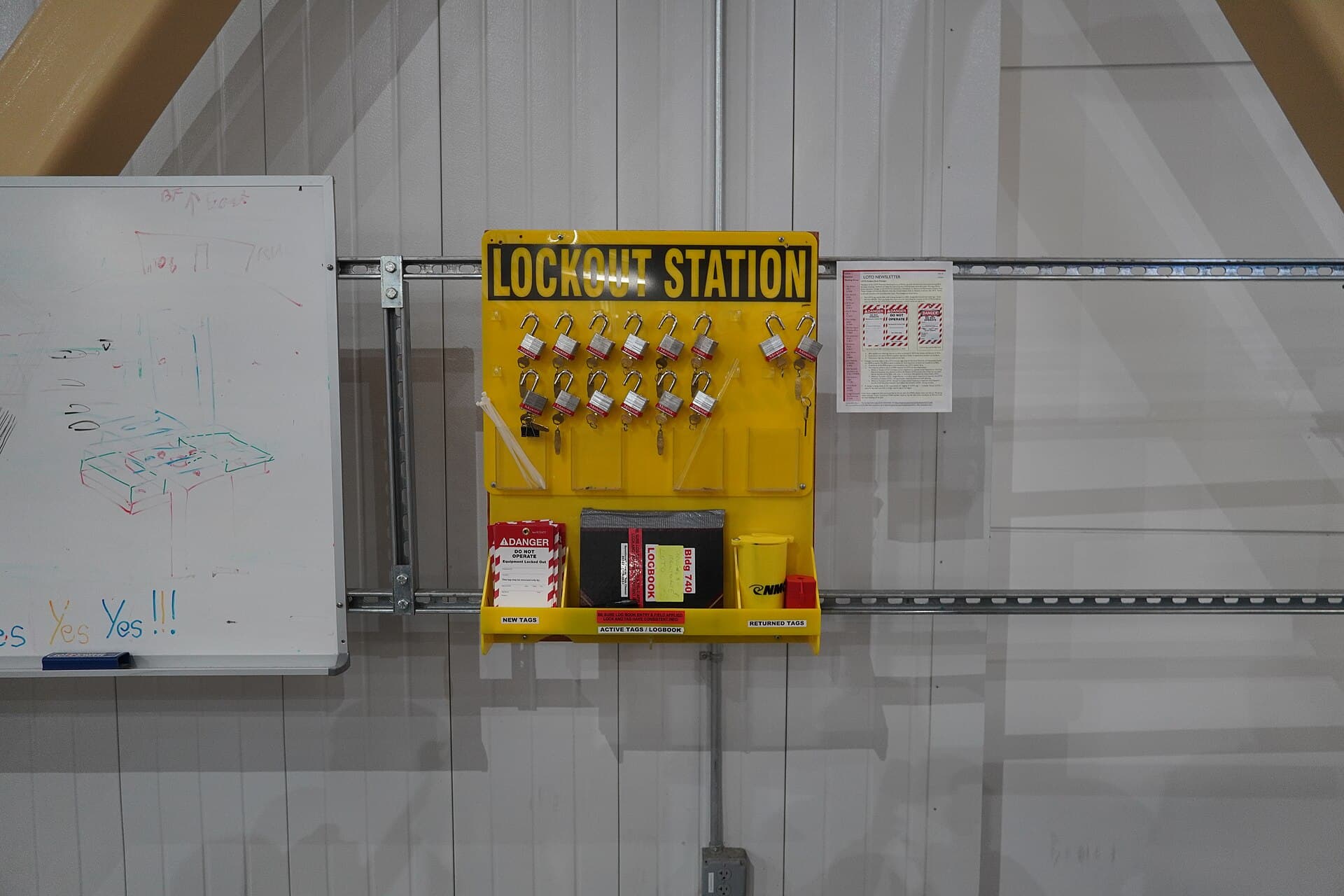
Then securing and tagging. Personal locks, hasps, group lock-boxes. Who holds the key. How a second worker joins the isolation. How you prevent the "workshop lock" whose key is in the supervisor's car. The isolation article in this hub is the reference; the SWMS is the instance.
Then prove-dead. Test the tester on a known live source. Test the conductors at the point of work. Test the tester again. Name the instrument in general terms ("two-pole voltage tester, in-test") if you do not know which kit will be on the van, and require a check of the kit before the test. Say that panel voltmeters are not enough. Say that you re-test after any absence. Say that unidentified conductors are live.
Then the work itself, in the order it will happen, with the remaining hazards — adjacent live parts, stored energy, work at height, the trench, the plant — given the same verb-level treatment.
Then restoration. Walk-down, covers, people clear, personal locks off, group locks off, re-energise in sequence, verification tests that the Wiring Rules require before you close in and sign. If the job may be left unfinished, write how it is left and who owns the locks overnight.
If the work is permitted live work, write the prescribed circumstance in a sentence a magistrate can read. Write the preliminary steps from the regulation: recorded risk assessment, clear access and exit, identified isolation point, authorisation after consultation. Write the observer's job. Write the stop points. Do not bury them under a generic PPE list.
Testing belongs in the method as work, not as an afterthought. Queensland has said that testing of energised equipment, including testing for dead, is energised electrical work. Other jurisdictions have not all used those words. Your SWMS should still treat the tester as a live-work tool: competent person, suitable instrument, no casual contact.
Reviews after incidents, and reviews before them
The model regulations require a SWMS to be reviewed and revised if the control measures are revised. That is the legal minimum. It is also common sense after a near miss, an incident, a change of method, a change of board, or a moment when the crew could not follow the document as written.
A review is not a new logo. It is a conversation: what did we say we would do, what did we do, where did the document lie, what will we change. If the isolation point in the SWMS did not exist, the next SWMS names a real one. If a tenant restored supply because the tag was on the wrong door, the next SWMS puts the lock on the device and the consultation in the method. If an observer was also pulling in a sub-main, the next SWMS says the observer does not have a second job.
Review after a quiet job that felt wrong. The SWMS that "worked" because nobody touched the live side is not validated. It was lucky. Luck is not a control you can show an inspector.
Version the document. Date it. Keep the old one. The construction regulations require the SWMS to be kept, and to be available to the workers who will use it. A current version in a glovebox and a superseded version on the gate system is how two methods exist at once. Pick one, and make it the one on the tools.
What inspectors look for
They look for a document that could only have been written for this job. They look for isolation and prove-dead in steps. They look for the high-risk construction work item that triggered the SWMS, named as such, not hidden in a soup of hazards. They look for consultation that left a trace — names, a time, a change that came from the crew. They look for a copy that workers can get at. They look at the kit and ask whether it matches the method: locks, hasps, testers, shrouds, PPE.
They ask people questions. What is the isolation point. What do you do if you cannot prove dead. Who is the observer. What is the prescribed circumstance. An apprentice who cannot answer is not automatically a failed contractor, but a whole crew that has never seen the document is.
They compare the SWMS with the electrical safety paperwork — certificates, test results, licences. A SWMS that says the work was isolated and a certificate that could not have been issued without a live test you did not control will be noticed. So will a SWMS that claims live work on a job whose licence class does not cover it.
They know the generic PDF. They have a pile of them. Do not add to it.
Penalties for not having a SWMS, or for not following one, sit in the WHS regulations of the state or territory. They are set in penalty units. The dollar value changes. Check the current instrument; do not recycle a figure from a 2019 slide deck.
A SWMS that will be used
Write it short enough to read on a phone in a switchroom. Put the isolation and test sequence on the first page, not after three pages of corporate policy. Use the company's standard isolation method as a referenced appendix if you must, and put today's board on the front. Sign-on after the crew has walked the isolation points, not before. Leave space to amend in ink when the board is not what the drawing said, and then transfer that amendment to the file.
Tie it to the rest of the safety and testing system. Isolation hardware, RCD tests, testers in calibration, licences, and the SWMS should tell the same story. If the SWMS says every socket circuit has 30 mA Type A additional protection and the board is still Type AC, someone should notice before the inspector does.
The contracting-business reason for doing this well is not a mystery. A method that the crew will follow is faster than a stop-work, cheaper than a serious incident, and the only document worth having when a client asks, after the job, how you did it.
SWMS checklist for electrical work
- Decide whether this is high-risk construction work, energised electrical work, or both. If it is neither, do not invent a fake SWMS — isolate anyway.
- Name the site, the equipment, the board and every source of supply.
- Write isolation, securing, tagging and prove-dead as numbered verbs. Point to the isolation article's sequence, then instance it.
- Write restoration and unfinished-work steps. Say who owns the locks overnight.
- If the work is live or near live parts, write the prescribed circumstance, the preliminary steps, the observer and the stop points.
- Include the other HRCW items that are actually present — falls, plant, trenches, asbestos — in the same verb-level style.
- Consult the crew and the person in control of the workplace. Change the document when they tell you it is wrong.
- Make a copy available on the job, not only on a portal.
- Review after a change, a near miss or an incident. Version and keep.
- Ask one person on the tools to explain the isolation point. If they cannot, the SWMS is not finished.
A SWMS that people use is a set of instructions for this afternoon. Everything else is filing.
Questions contractors ask
- Does every electrical job need a SWMS?
- No. Under the model WHS regulations a SWMS is required for high-risk construction work, including construction work on or near energised electrical installations or services, and for electrical work on energised equipment. Other electrical work still needs risk management. Many principal contractors will ask for a SWMS anyway. Write one that matches the trigger, not a novel about every hazard on earth.
- Can I reuse last month's SWMS if the work is similar?
- You can reuse the bones — the isolation sequence, the prove-dead steps, the observer rules — if you rewrite the site, the board, the sources and the names. A document that still says "Building B, Board 3" when you are in Building D is not a method. It is a liability.
- Who has to keep the SWMS?
- The PCBU that carries out the high-risk construction work prepares it, keeps it, follows it and reviews it, and gives a copy to the principal contractor. Workers must be able to get at it. "It is in the office" is not readily accessible on a Saturday call-out.